LOCAL GOVERNMENT CRAFT WORKERS PAY OFFERS 2025/26 & 2026/27
Posted on:
Dear Colleague
LOCAL GOVERNMENT CRAFT WORKERS PAY OFFERS 2025/26 & 2026/27
Further to my May 2025 Bulletin, the August 2025 update and the July 2026 update - see both updates on the noticeboard below - where I advised you that following submission of our pay claim (see here) the National Employers made the following full and final one year offer:
With effect from 1 April 2025, an increase of 3.20% on basic salary
With effect from 1 April 2025, an increase of 3.20% on all allowances (as listed in the 2024 JNC pay agreement circular dated 1 November 2024)
The other elements of the claim were all rejected.
In a subsequent ballot GMB members voted to accept the offer but Unite members voted to reject it as they were unhappy with the potential grading of the Building Labourer, the use of apprentices and the potential use of job evaluation.
Since then, Unite continue to insist that they would never accept the offer and the employers insist it is a full and final offer. Unite advised that they will take industrial action in pursuit of their demands and apparently have done so in a handful of depots around the country. This has not deterred the employers from reiterating that the offer made on 22 April 2025 was full and final.
Unite recently contacted us with a proposal to resolve the[ir] dispute by noting the offers of 3.2% and 3.3% in 25/26 and 26/27 respectively and asking us to support discussions about the other matters at the employers AGM next month.
GMB Red Book reps and officers met on Wednesday 9th
September to discuss this proposal and overwhelmingly rejected it. We advised Unite that, following a meeting of our regional colleagues and reps, that we are unable to support their proposal and our position (of acceptance) will not be changing.
We added that GMB members “continue to be frustrated at the delay and have asked that we call on you and the LGA to resolve last year's dispute speedily and arrange for payment of last year's pay offer that we accepted.”
I have yet to receive their response.
I can also advise you that we will shortly start consulting our members over this year's (2026/27) pay aspirations and we will work collectively with Unite to do so hoping that this will start ASAP.
I remain in contact with the employers and Unite urging them both to move forward on this issue.
George Georgiou
GMB National Officer: Local Government Craft Workers
LOCAL GOVERNMENT CRAFT WORKERS PAY OFFER 2025/26 – STILL NO PROGRESS!
Posted on:
Dear Colleague
Further to my May 2025 Bulletin and the August 2025 update on the GMB notice board below where I advised you that following submission of our pay claim, also below, the National Employers made the following full and final one year offer:
With effect from 1 April 2025, an increase of 3.20% on basic salary
With effect from 1 April 2025, an increase of 3.20% on all allowances (as listed in the 2024 JNC pay agreement circular dated 1 November 2024)
The other elements of the claim asking for
A shorter working week
An increase in Annual Leave
JNC Craft Apprentice pay rates
were all rejected.
In a subsequent ballot GMB members voted to accept the offer but Unite members voted to reject it as they were unhappy with the potential grading of the Building Labourer, the use of apprentices and the potential use of job evaluation. Since then, there has been much to-ing and fro-ing between Unite and the employers, the former insisting that they would never accept the offer and the employers insisting it is a full and final offer.
Unite have advised that they will take industrial action in pursuit of their demands.
In recent correspondence (8th June 2026), the employers reiterate that the offer made on 22 April 2025 is full and final.
Regarding Building Labourer grade the employers state that
“the 2016-18 JNC agreement aligned the five Craft Grades to pay points 2, 3, 4 and 5 respectively on the NJC ‘Green Book’ pay spine. On 1 April 2026, NJC pay point 2 was permanently deleted, meaning from that date NJC pay point 3 is the bottom pay point. As a result, the Building Labourer grade JNC-specific rate of pay must by necessity align with NJC pay point 3 from 1 April 2026.
However, we have been unable to find a single Craftworker employed as a Building Labourer on a JNC-specific rate. Therefore, to the best of our knowledge, the deletion of pay point 2 from the NJC spine on 1 April 2026 has had no impact whatsoever on any individual Craft employee”.
The employers add
“that if Unite was able to provide an example of a Building Labourer currently employed directly by a council on the specific JNC Craft 2024 pay rate of £23,656 per annum (£453.68 per week), the National Employers would be willing to discuss with the employer[s] the appropriate action it needed to take.”
The employers reiterate that
“there is nothing in the employers’ offer that will unpick existing local arrangements on this issue.”
Regarding JNC Craft Apprentices the employers state
“In councils in which Craft Apprentices are employed we have been unable to find any who are being paid on the specific rates of pay set out in the most recent JNC pay circular (dated 1 November 2024). The employers therefore see no purpose in the JNC continuing to update and publish pay rates that are not being used.
However, as with the Building Labourer grade issue, if Unite is able to identify any council employer that is paying an apprentice on the JNC rates, we will be pleased to advise that employer.”
On 12th June 2026 Unite responded to the above stating that the employers are misrepresenting the position. They say
“We are agreed on the Building Labourer Grade moving to Pay Point 3” and are clear “that if all grades are not moved up, we will have, for the purposes of a standard set nationally, a new entrant on the same banding as a qualified, competent Craft Worker. We cannot accept this and your suggestion to resolve this through job evaluation going forward is equally unacceptable.”
Unite continue
“The Agreement establishes the benchmark upon which regional and local bargaining can build. That includes apprentices within the bargaining unit and supports progression through industry. I remain unconvinced by any argument that apprentices should be excluded from those arrangements. Indeed, the fact that some may benefit from higher locally negotiated rates only reinforces the value of retaining them within the nationally agreed structure.
The suggestion that apprentices should be removed from the bargaining unit simply because some may receive higher rates through local agreements is neither logical nor consistent with the purpose of the Agreement.
I am unsure why this commonsense position, that has been in place since the Agreement came into practice, cannot be agreed going forward. This appears to be part of a wider attempt to introduce job evaluation as the preferred mechanism for determining rates. That position was clearly communicated by the National Employers in August and, despite the concerns raised …there has, to date, been no indication that this position has changed.”
Finally, earlier today, we have been notified of further correspondence from the employers, where they reiterate that Unite’s
“…unnecessary action serves only to further delay all Craftworkers, whether union members or not, from receiving their long overdue 2025/26 pay award”.
They continue
“Since making their offer, the employers have reaffirmed to Unite numerous times …that their offer is full and final. The National Employers see no reason for Craftworkers to receive a different pay offer from the ones made to (and accepted by) the other local government bargaining groups (NJC for local government services; JNCs for Chief Officers and Chief Executives), all of whom received their 3.20 per cent 2025/26 pay awards almost a year ago.
“The National Employers have been consistently clear with Unite that nothing in their offer will unpick existing local working arrangements with regard to the two “non-pay” elements: the Building Labourer grade and JNC Craft Apprentices. In any council in which a Building Labourer is employed on a local rate of pay, they will remain on that rate of pay (subject to the proposed 3.20 per cent increase) and the differential between that employee’s role – and pay rate - and other Craft roles / pay will remain, as now, entirely a matter for local determination.”
“The National Employers, contrary to Unite’s messaging to its members, are not seeking to ‘impose a job evaluation process without agreement.’ There is no mechanism by which the national employers could do so. However, the employers’ opinion that Craftworkers should be included in local pay and grading reviews is of longstanding (almost 30 years, since Single Status was introduced in 1997), so should not come as a surprise to anyone”.
“In councils in which Craft Apprentices are employed, we have been unable to find any who are being paid on the specific rates of pay set out in the most recent JNC pay circular (dated 1 November 2024). The employers therefore see no purpose in the JNC continuing to update and publish pay rates that are not being used. This does not mean…that the employers are proposing the ‘unilateral removal of the apprentice structure from union agreements.”
“The National Employers want to be able to pay JNC Craftworkers the same 3.20 per cent increase that other local government employees received almost a year ago. We hope local Unite members – none of whom to the best of our knowledge will be impacted by either of the two issues above – will urge their national officials to end this dispute so the 2025 pay award can finally be implemented.”
Whilst the above is being played out GMB members are frustratingly waiting for their pay award - and the 12 months back pay that will come with it – to be implemented. We are also ready to commence the 2026/27 pay talks which remain outstanding.
I remain in contact with the employers and Unite urging them both to move forward on this issue.
George Georgiou
GMB National Officer Local Government Craft Workers
GMB Craft Workers 2025 Pay Offer
Posted on:
Dear Members,
Please click here to read a letter asking the employers to reconsider this year’s pay offer: craft-workers-gmb.pdf
Local Government Craft Worker's 2025 Pay Ballot Timeline
Posted on:
Dear Members,
Further to my May Bulletin where I advised you that following submission of our pay claim (see here) the National Employers made the following full and final one year offer:
With effect from 1 April 2025, an increase of 3.20% on basic salary
With effect from 1 April 2025, an increase of 3.20% on all allowances (as listed in the 2024 JNC pay agreement circular dated 1 November 2024)
The other elements of the claim asking for:
A shorter working week
An increase in Annual Leave
JNC Craft Apprentice pay rates
were all rejected.
I remind you that following consultation with GMB Craft Worker Officers and Reps, it was agreed, in line with the recommendation for the main NJC staff groups, to recommend rejection of the offer noting that a vote to reject is also a vote in favour of a move to a formal ballot for industrial action. For a formal ballot for industrial action to take place, GMB will need at least half of our members to vote for a rejection.
The ballot is currently open and will close at noon on Friday 20th
June.
If you have not yet voted please do so, ballot papers are available for your Regional Office
Local Government Craft Workers' Pay Offer 2025
Posted on:
We have received a full and final offer from the employers of 3.2% on salaries and allowances.
We are putting this offer to members with a recommendation to reject by way of indicative ballot, in the knowledge that a rejection of the offer will lead to industrial action should the statutory thresholds be reached.
The ballot opens on Monday the 12th of May 2025 and closes at noon on Friday the 20th
of June 2025.
Ballot papers are available via your regional office.
LOCAL GOVERNMENT CRAFT WORKERS PAY OFFER 2025
Posted on:
You will be aware that in February the GMB submitted an above inflation pay claim for Local Government Craft Workers asking for
An increase of at least 9% for craft rates taking into account NMW rate for Apprentices, differentials and cost of living challenges
Pro rata Increase to all other allowances and plus payments
A reduction in the working week to 35 hours with no loss of pay
In response the National Employers consulted councils and have now made the following full and final one year offer (bearing in mind that on 11 June the government will be announcing the details of its spending review, and they are hopeful that it will provide councils with a three-year funding settlement which could allow councils, from 2026 onwards, to consider alternatives to the one-year pay offers of recent years which would require meaningful negotiations with the Trade Unions. )
With effect from 1 April 2025, an increase of 3.20% on basic salary
With effect from 1 April 2025, an increase of 3.20% on all allowances (as listed in the 2024 JNC pay agreement circular dated 1 November 2024)
For those few Craft employees who are paid the specific annual salaries as set out in the Craft JNC 2024 pay agreement, the Employers’ full and final offer is as follows:
With effect from 1 April 2025:
3.20% on Building Labourer grade (equivalent to SCP2 on the NJC spine)
3.20% on Heating & Ventilation Mate grade (equivalent to SCP3 on the NJC spine)
3.20% on Building Operative grade (equivalent to SCP3 on the NJC spine)
3.20% on Plumber grade (equivalent to SCP4 on the NJC spine)
3.20% on Engineer & Electrician grade (equivalent to SCP5 on the NJC spine)
3.20% on all allowances
Building Labourer grade from 1 April 2026
A principle was agreed by the JNC in the 2016-18 agreement to align the five Craft Grades to current pay points 2, 3, 4 and 5 respectively on the NJC ‘Green Book’ pay spine. This year’s offer therefore also includes a proposal to delete SCP 2 from the NJC spine with effect from 1 April 2026. Therefore, as the Building Labourer grade salary is aligned with SCP2 the National Employers propose that employers who apply the JNC pay rates should (in the event agreement is reached with the NJC unions to delete SCP 2), with effect from 1 April 2026, align this JNC Craft grade salary with SCP3 on the NJC spine.
Other elements of your claim:
Working week: The Employers reject this element of the claim in relation to a proposed 35-hour week (34 in London) stating that such a reduction would be out of line with norms in local government and would result in an increase in costs that would adversely affect local authority services.
Annual Leave: The Employers reject this element of the claim. All Craft employees currently receive a minimum of 22 days’ leave, plus two extra statutory days, with a further four days after five years’ service (28 days). This is equitable to NJC employees’ minimum annual leave entitlement of 28 days (after five years’ service). Many councils have a more generous basic leave entitlement for both groups of employees.
JNC Craft Apprentice pay rates: As only 32 councils said they directly employ Craftworkers on ‘Red Book’ conditions and of those 32 councils only 9 apply the JNC pay rates.
The employers continued that each year, the Low Pay Commission (LPC) makes its recommendation to government of what it believes the National Minimum Wage (NMW) and National Living Wage (NLW) rates should be. With this principle in mind, the National Employers propose that the JNC should immediately cease issuing rates of pay for Craft apprentices and instead leave such matters to local determination (and in accordance with the employer’s legal requirement to apply at least the statutory National Minimum Wage apprentice pay rate of £7.55 from 1 April 2025).
The GMB NJC/Schools Committee will be meeting to discuss this offer on Friday 2nd May in conjunction with the offers received for Local Government Chief Officers and Green Book staff. I shall advise further following that meeting.
Local Government Craft Workers Pay Claim 2025/26
Posted on:
Dear Members,
Please see below the Joint Negotiating Committee for Local Authority Craft and Associated Employees pay claim for 2025/26:
GMB is consulting Local Government Craft Workers on their aspirations for the forthcoming pay award. Please complete the pay survey in order to inform us of your view; simply follow the link and answer a few simple questions! https://forms.office.com/e/riUzHh2Vzz
LOCAL GOVERNMENT CRAFT WORKERS PAY 2024 – GMB ACCEPT THE OFFER
Posted on:
GMB submitted its pay claim for Local Government Craft Workers in March. In response the National Employers made the following, full and final one-year (1 April 2024 to 31 March 2025) offer in respect of those employees whose pay is determined by contractual reference to the Craft JNC National Agreement (‘Red Book’):
“For all Craft JNC employees (regardless of job title and designation) whose rate of pay differs from the salaries set out in the Craft JNC 2023 pay agreement circular (dated 16 November 2023), but is still contractually linked to the annual settlement reached by the Craft JNC, the Employers’ final offer is as follows:
With effect from 1 April 2024, an increase of £1,290 on basic salary
With effect from 1 April 2024, an increase of 2.50 per cent on all allowances (as listed in the 2022 JNC pay agreement circular dated 16 November 2023)
For those few Craft employees who are paid the specific annual salaries as set out in the Craft JNC 2022 pay agreement, the Employers’ full and final offer is as follows:
With effect from 1 April 2024:
£1,290 on Building Labourer grade (equivalent to SCP2 on the NJC spine)
£1,290 on Heating & Ventilation Mate grade (equivalent to SCP3 on the NJC spine)
£1,290 on Building Operative grade (equivalent to SCP3 on the NJC spine)
£1,290 on Plumber grade (equivalent to SCP4 on the NJC spine)
£1,290 on Engineer & Electrician grade (equivalent to SCP5 on the NJC spine), and
2.5% on all allowances
These increases would continue the principle agreed by the JNC in the 2016-18 agreement to align the five Craft Grades to current pay points 2, 3, 4 and 5 respectively on the NJC ‘Green Book’ pay spine.”
Other elements of the claim - a reduction in the working week to 35 hrs (34 in London), an increase in annual leave and payment for the use of technology - were rejected by the employer
Despite members initially rejecting the offer in an indicative ballot, further discussions and meetings with members and reps at our respective craft worker depots made it clear that there was no majority view to pursue the matter to a formal industrial action ballot at this stage.
We have therefore advised the employers of our acceptance of the offer.
PAY 2024 – WILL YOU TAKE ACTION?
Posted on:
Dear GMB Craft Worker,
Further to the recent ballot in respect of this year’s pay offer you will recall that the GMB submitted its pay claim for Local Government Craft Workers in April 2024.
Our claim was for
A 10% or £3,000 increase in pay
A reduction in the working week to 35 hours
An additional 2 days of annual leave
Increase in Tool insurance
Charging/responsibility payment for tools, phones, tablets etc.
In response the employers made the following, full and final one-year (1 April 2024 to 31 March 2025) offer:
With effect from 1 April 2024, an increase of £1,290 on basic salary
With effect from 1 April 2024, an increase of 2.50 per cent on all allowances
All other elements of the claim were rejected
In an indicative ballot of members that closed on 12th July 2024, 60.5% of members voted to reject the offer and 39.5% voted to accept – the turnout was 36%.
On 23rd July we held further talks with the employers advising them of our rejection and asking them to revisit their offer. They simply reiterated that the offer was full and final and they will not improve it.
Your officers and representatives are therefore asking you whether you are prepared to take industrial action to pursue the claim and a ballot paper is enclosed for you to complete and return.
In order to take lawful industrial action we must achieve a 50% Yes vote by at least 50% of those entitled to vote. If we do not meet this threshold we will have no option but to accept the offer
It is very important that you have your say on pay so make sure you use your vote.
The ballot closes at 12 noon on Friday 27th September 2024
The ballot is being run by your Regional Office, please contact them directly for further details
LOCAL GOVERNMENT CRAFT WORKERS PAY 2024 – OFFER REJECTED
Posted on:
Further to my bulletin of May 2024 you will be aware that the GMB submitted its pay claim for Local Government Craft Workers to employers in April.
Our claim was for
A 10% or £3000 increase in pay (flat rate to increase with inner and outer London figures as a %)
A reduction in the working week to 35 hours with no loss of pay
An additional 2 days of annual leave
Increase in Tool insurance
Charging/responsibility payment for tools, phones, tablets etc.
In response the employers made the following, full and final one-year (1 April 2024 to 31 March 2025) offer:
With effect from 1 April 2024, an increase of £1,290 on basic salary
With effect from 1 April 2024, an increase of 2.50 per cent on all allowances
All other elements of the claim were rejected
GMB held an indicative ballot of members with a neutral recommendation which closed last Friday 12th July 2024.
On a 36% turnout GMB Local Government Craft Workers have 60.5% of members voted to reject the offer and 39.5% voted to accept.
I have advised the employers of our position and we will be holding further talks with them next Tuesday 23rd July. I shall advise you of the outcome of the talks as soon as practicable after that date.
Local Government Craft Workers Pay 2024
Posted on:
GMB submitted its pay claim for Local Government Craft Workers in March. In response the National Employers have made the following, full and final one-year (1 April 2024 to 31 March 2025) offer in respect of those employees whose pay is determined by contractual reference to the Craft JNC National Agreement (‘Red Book’), as follows:
“For all Craft JNC employees (regardless of job title and designation) whose rate of pay differs from the salaries set out in the Craft JNC 2023 pay agreement circular (dated 16 November 2023), but is still contractually linked to the annual settlement reached by the Craft JNC, the Employers’ final offer is as follows:
With effect from 1 April 2024, an increase of £1,290 on basic salary
With effect from 1 April 2024, an increase of 2.50 per cent on all allowances (as listed in the 2022 JNC pay agreement circular dated 16 November 2023)
For those few Craft employees who are paid the specific annual salaries as set out in the Craft JNC 2022 pay agreement, the Employers’ full and final offer is as follows:
With effect from 1 April 2024:
£1,290 on Building Labourer grade (equivalent to SCP2 on the NJC spine)
£1,290 on Heating & Ventilation Mate grade (equivalent to SCP3 on the NJC spine)
£1,290 on Building Operative grade (equivalent to SCP3 on the NJC spine)
£1,290 on Plumber grade (equivalent to SCP4 on the NJC spine)
£1,290 on Engineer & Electrician grade (equivalent to SCP5 on the NJC spine), and
2.5% on all allowances
These increases would continue the principle agreed by the JNC in the 2016-18 agreement to align the five Craft Grades to current pay points 2, 3, 4 and 5 respectively on the NJC ‘Green Book’ pay spine.”
Other elements of the claim:
Working week (A reduction to 35 hrs (34 in London))
The Employers rejected this element of the claim stating that such a reduction would be out of line with norms in local government and would result in an increase in costs that would adversely affect local authority services.
Increase in Annual leave
The Employers have rejected this element of the claim stating that all Craft employees currently receive a minimum of 22 days’ leave, plus two extra statutory days, with a further four days after five years’ service (28 days). This is equitable to NJC employees’ minimum annual leave entitlement of 28 days (after five years’ service). Many councils have a more generous basic leave entitlement for both groups of employees.
Tool Allowance and Tool Insurance
The Employers’ offer is set out above i.e. that tool allowance is increased by 2.5% with effect from 1 April 2024. Similarly, in relation to tool insurance, the Employers’ offer is that it is increased by 2.5% with effect from 1 April 2024.
Use of Technology
The Employers consider the use of technology to be an increasingly common practice in the modern workplace that does not merit additional recompense nor a new national agreement. Therefore, the Employers reject this element of the claim.
GMB will commence consultation on this offer as soon as practicable
Local Government Craft Workers Pay Claim 2024
Posted on:
Following a recent survey of GMB Craft Worker members we have worked with other Trade Unions who represent Local Government Craft Workers and compiled the attached joint pay claim
We have submitted the claim to the employers and we are expecting a response in the first week of May
We shall course advise you as soon as we receive their response
Further to my earlier bulletin please find via the link below the revised pay scales for Local Government Craft Workers following our acceptance of the offer.
Employers have been encouraged to implement this pay award as swiftly as possible.
LOCAL GOVERNMENT CRAFT WORKERS PAY 2023 – OFFER ACCEPTED
Posted on:
You will be aware that the GMB submitted an above inflation pay claim for Local Government Craft Workers in February 2023.
We also asked for:
Recruitment and Retention Payment (RRP)
A 35hr Working Week (34 in London)
An additional day of Annual Leave
Payment for Use of Technology
In response the Employers made a one-year (1 April 2023 to 31 March 2024) offer of;
With effect from 1 April 2023, an increase of £1,925 on basic salary
With effect from 1 April 2023, an increase of 3.88% on all allowances
They rejected all other elements of the claim.
We advised the employers that this was not acceptable to us and at a second meeting we urged them to improve the offer. They did not do so, simply confirming that this is a full and final offer.
We therefore carried out an indicative ballot of our members who, on a turnout of 57% rejected the offer by 59% to 41%. However, in the formal disaggregated ballot for Industrial Action that followed the indicative ballot we only reached the threshold for action in one depot.
Following a meeting on Tuesday 13th November representatives and officers took the view that action by one depot alone would not provide enough leverage to force the employers to improve the offer. Also the current cost of living crisis and the impending festive season had led to members wanting early payment of the award and arrears.
The meeting therefore agreed that the ballot had presented us with a welcome organising and recruitment opportunity, but the time was right to now advise employers of our acceptance of the award. We did so earlier today.
The meeting also agreed that pay talks and organising opportunities should commence earlier in 2024 and we agreed therefore to meet again in January to discuss our approach.
LOCAL GOVERNMENT CRAFT WORKERS PAY 2023
Posted on:
You will be aware that the GMB submitted an above inflation pay claim for Local Government Craft Workers in February 2023.
We also asked for:
Recruitment and Retention Payment (RRP)
A 35hr Working Week (34 in London)
An additional day Annual Leave
Payment for Use of Technology
In response the Employers made a one-year (1 April 2023 to 31 March 2024) offer of;
With effect from 1 April 2023, an increase of £1,925 on basic salary
With effect from 1 April 2023, an increase of 3.88% on all allowances
Regarding the other elements of the claim they stated:
RRPs are a matter for local determination.
A shorter working week is out of line with local government norms and would increase employer costs.
All Craft employees currently receive a minimum of 22 days’ leave, plus 2 statutory days, with a further 4 days after 5 years’ service. Many councils have a more generous basic leave entitlement.
The use of technology is common practice in the modern workplace and does not merit additional recompense.
We advised the employers that this was not acceptable to us and at a second meeting we urged them to improve the offer. They did not do so, simply confirming that this a full and final offer.
We therefore carried out an indicative ballot of our members who, on a turnout = 57%, rejected the offer by 59% to 41%.
Next Steps
We will now move to a disaggregated industrial action ballots of GMB craft workers following the same timeline as the National NJC Ballot i.e. the Ballot will open on 12th September and close on the 24th October. More details are available from your Regional Office.
LOCAL GOVERNMENT CRAFT WORKERS PAY 2023
Posted on:
You will be aware that the GMB submitted an above inflation pay claim for Local Government Craft Workers in February 2023.
We also asked for:
Recruitment and Retention Payment (RRP)
A 35hr Working Week (34 in London)
An additional day Annual Leave
Payment for Use of Technology
In response the Employers made a one-year (1 April 2023 to 31 March 2024) offer of;
With effect from 1 April 2023, an increase of £1,925 on basic salary
With effect from 1 April 2023, an increase of 3.88% on all allowances
Regarding the other elements of the claim they stated:
RRPs are a matter for local determination.
A shorter working week is out of line with local government norms and would increase employer costs.
All Craft employees currently receive a minimum of 22 days’ leave, plus 2 statutory days, with a further 4 days after 5 years’ service. Many councils have a more generous basic leave entitlement.
The use of technology is common practice in the modern workplace and does not merit additional recompense.
We advised the employers that this was not acceptable to us and at a second meeting we urged them to improve the offer. They did not do so, simply confirming that this a full and final offer.
We therefore carried out an indicative ballot of our members who, on a turnout = 57%, rejected the offer by 59% to 41%.
Next Steps
We will now move to industrial action ballots of GMB craft workers. More details and a timeline will follow in the coming weeks.
This is another organising opportunity where we can utilise the ballot to enter workplaces and build Red Book membership.
LOCAL GOVERNMENT CRAFT WORKERS PAY 2023
Posted on:
GMB submitted its pay claim for Local Government Craft Workers in February. In response the National Employers made a full and final one-year (1 April 2023 to 31 March 2024) offer of:
With effect from 1 April 2023, an increase of £1,925 on basic salary
With effect from 1 April 2023, an increase of 3.88 per cent on all allowances
We put this offer to our members in an indicative ballot that closed on 28th April 2023
The result of that ballot is as follows:
Ballot Papers Sent - 313
Ballot Papers Returned - 178 (Turnout = 57%)
Those voting to Accept - 73 (41%)
Those voting to Reject - 105 (59%)
Unite members have also rejected the offer and called for further talks with the employers whilst also advising that they are preparing for an industrial action ballot, I will seek further information from Unite regarding their ballot timelines.
I have also advised the employers that GMB have rejected the offer and we are awaiting the employer's response.
On aggregate we have clearly passed the threshold for an industrial action ballot and a meeting will be held shortly to discuss next steps bearing in mind any proposed action for the national NJC Ballot.
Noticeboard Bulletin - 27-03-2023
Posted on:
GMB submitted its pay claim for Local Government Workers in February. In response the National Employers made the following, full and final one-year (1 April 2023 to 31 March 2024) offer:
“For all Craft JNC employees the Employers’ final offer is as follows:
With effect from 1 April 2023, an increase of £1,925 on basic salary
With effect from 1 April 2023, an increase of 3.88 per cent on all allowances
These increases would continue the principle agreed by the JNC in the 2016-18 agreement to align the five Craft Grades to current pay points 2, 3, 4 and 5 respectively on the NJC ‘Green Book’ pay spine.
With regard to the other elements of our claim the employers have responded:
Tool Allowance and Tool Insurance – both to be increased by 3.88% with effect from 1 April 2023.
Recruitment and Retention Payment – The employers have stated that this is entirely a matter for local determination, rather than the JNC and therefore the reject this element of the claim.
A 35hr Working Week (34 in London)
The Employers have rejected this element of the claim stating “Such a reduction would be out of line with norms in local government and would result in an increase in costs that would adversely affect local authority services.’
An additional day Annual Leave
The Employers have rejected this element of the claim stating “All Craft employees currently receive a minimum of 22 days’ leave, plus two extra statutory days, with a further four days after five years’ service (28 days)...Many councils have a more generous basic leave entitlement… “
Payment for Use of Technology
The Employers have rejected this element of the claim stating they consider the use of technology to be common practice in the modern workplace that does not merit additional recompense…”
GMB Craft Worker members have considered this offer and in the light of the ongoing cost of living crisis have agreed to recommend REJECTION of this offer in an indicative ballot.
Ballot papers are being issued by GMB Regions with the ballot set to open on Monday 27th March and close at noon on Friday 28th April 2023.
Once all ballot papers have been received and counted, in the event of us reaching the threshold for industrial action, we will then seek views on what form of industrial action members are willing to take and proceed to a formal ballot for action.
Craftworker Pay 2022/23
Posted on:
LOCAL GOVERNMENT CRAFT WORKERS PAY 2023
GMB submitted its pay claim for Local Government Workers in February. In response the National Employers have made the following, full and final one-year (1 April 2023 to 31 March 2024) offer:
“For all Craft JNC employees (regardless of job title and designation) whose rate of pay differs from the salaries set out in the Craft JNC 2022 pay agreement circular (dated 10 November 2022), but is still contractually linked to the annual settlement reached by the Craft JNC, the Employers’ final offer is as follows:
With effect from 1 April 2023, an increase of £1,925 on basic salary
With effect from 1 April 2023, an increase of 3.88 per cent on all allowances
For those few Craft employees who are paid the specific annual salaries as set out in the Craft JNC 2022 pay agreement, the Employers’ final offer is as follows:
With effect from 1 April 2023:
£1,925 on Building Labourer grade (equivalent to SCP2 on the NJC spine)
£1,925 on Heating & Ventilation Mate grade (equivalent to SCP3 on the NJC spine)
£1,925 on Building Operative grade (equivalent to SCP3 on the NJC spine)
£1,925 on Plumber grade (equivalent to SCP4 on the NJC spine)
£1,925 on Engineer & Electrician grade (equivalent to SCP5 on the NJC spine), and
3.88 per cent on all allowances
These increases would continue the principle agreed by the JNC in the 2016-18 agreement to align the five Craft Grades to current pay points 2, 3, 4 and 5 respectively on the NJC ‘Green Book’ pay spine.
With regard to the other elements of our claim the employers have responded:
Tool Allowance and Tool Insurance – both to be increased by 3.88% with effect from 1 April 2023.
Recruitment and Retention Payment - This is entirely a matter for local determination, rather than the JNC and therefore the Employers reject this element of the claim.
A 35hr Working Week (34 in London)
The Employers reject this element of the claim stating “Such a reduction would be out of line with norms in local government and would result in an increase in costs that would adversely affect local authority services.’
An additional day Annual Leave
The Employers reject this element of the claim stating “All Craft employees currently receive a minimum of 22 days’ leave, plus two extra statutory days, with a further four days after five years’ service (28 days)...Many councils have a more generous basic leave entitlement…
Payment for Use of Technology
The Employers reject this element of the claim stating they consider the use of technology to be common practice in the modern workplace that does not merit additional recompense…
In line with the policy for NJC Green Book staff we will be seeking further negotiations with the employers as soon as practicable.
Joint Negotiating Committee for Local Authority Craft & Associated Employees
Posted on:
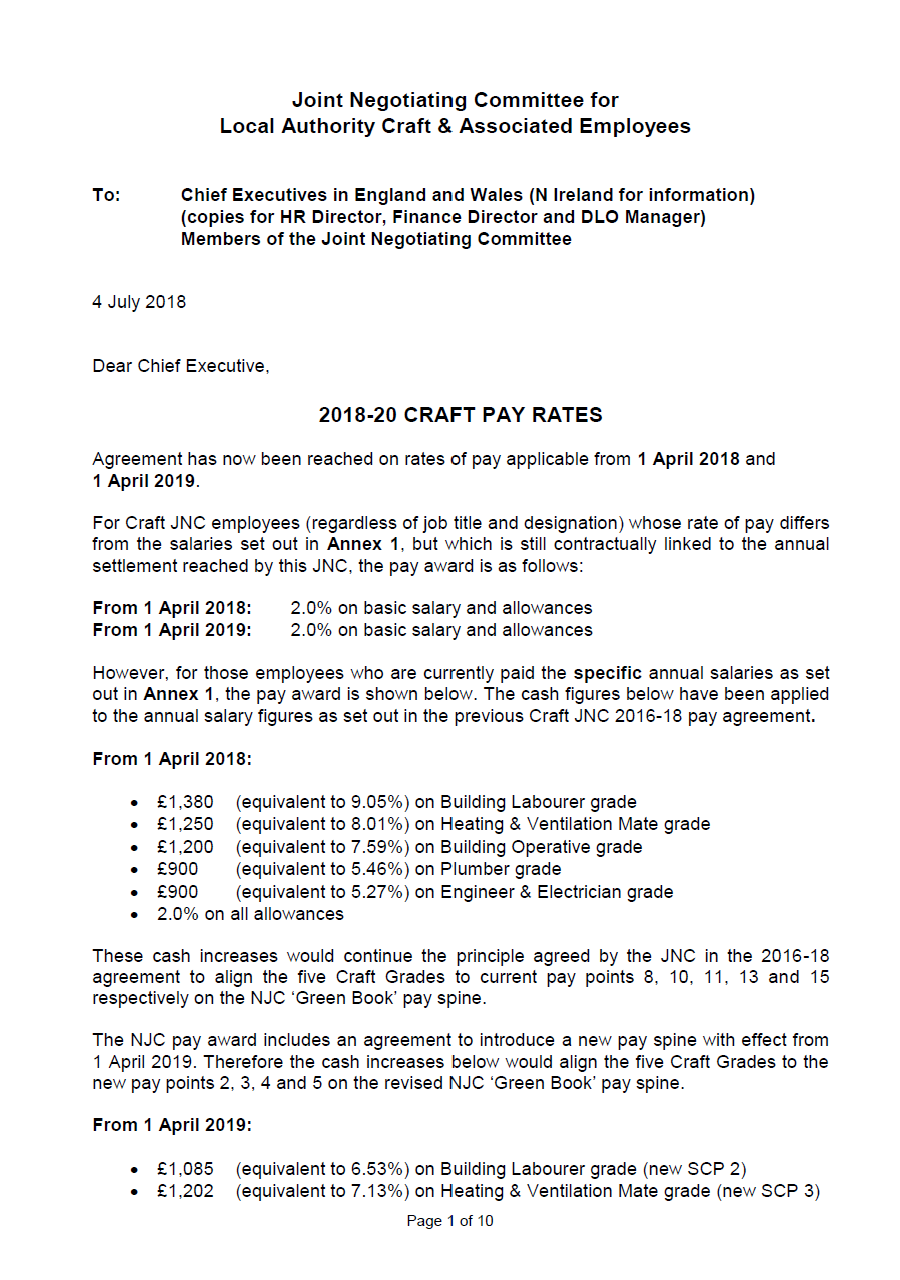
To: Chief Executives in England and Wales (N Ireland for information) (copies for HR Director, Finance Director and DLO Manager) Members of the Joint Negotiating Committee
Dear Chief Executive,
CRAFTWORKERS’ PAY AGREEMENT 2022
Employers are encouraged to implement this pay award as swiftly as possible.
Pay
Agreement has been reached on rates of pay applicable from 1 April 2022.
For Craft JNC employees (regardless of job title and designation) whose rate of pay differs from the salaries set out in Annex 1, but which is still contractually linked to the annual settlement reached by this JNC, the pay award is as follows:
From 1 April 2022: £1,925 on basic salary and 4.04 per cent on allowances
However, for those employees who are currently paid the specific annual salaries as set out in Annex 1, the pay award is as follows:
From 1 April 2022:
• £1,925 on Building Labourer grade (equivalent to NJC SCP2)
• £1,925 on Heating & Ventilation Mate grade (equivalent to NJC SCP3)
• £1,925 on Building Operative grade (equivalent to NJC SCP3)
• £1,925 on Plumber grade (equivalent to NJC SCP4)
• £1,925 on Engineer & Electrician grade (equivalent to NJC SCP5)
• 4.04 per cent on all allowances
These increases continue the principle agreed by the JNC in the 2016-18 agreement to align the five Craft Grades to current pay points 2, 3, 4 and 5 on the NJC ‘Green Book’ pay spine.
Backpay for employees who have left employment since 1 April 2022
If requested by an ex-employee to do so, we recommend that employers should pay any monies due to that employee from 1 April 2022 to the employee’s last day of employment.
When salary arrears are paid to ex-employees who were in the LGPS, the employer must inform its local LGPS fund. Employers will need to amend the CARE and final pay figures Page 2 of 10 (if the ex-employee has pre-April 2014 LGPS membership) accordingly. Further detail is provided in section 15 of the HR guide which is available on the employer resources section of www.lgpsregs.org
Yours sincerely,
Naomi Cooke, Unite
George Georgiou, GMB
GMB Local government Craft Workers to prepare for local disputes after national offer reluctantly accepted
Posted on:
GMB members working under the red book rejected the local government employer’s final offer as it fell short on a number of key points, with a majority of members voting against the offer. However, as the larger local government ‘green book’ membership have accepted the offer, it was reluctantly decided that it should be accepted for red book workers also. This will ensure that members receive a much needed pay boost and prevent employers from simply imposing the offer, especially on those working under hybrid red/green book conditions.
GMB Members are now focussing on local disputes to improve terms and conditions and are actively pursuing them. We will target council’s where red book workers are well organised and are fully prepared to undertake disputes to improve their terms and conditions. Where local members have clear issues and are willing to take industrial action, they will have our full support.
Many members remain disappointed that the offer nowhere near matches the requirement to match RPI nor does it address many other aspects of our claim. GMB members remain angry and will continue to fight to improve their working conditions in the light of the worst economic situation for decades.
Local Government Craft Workers Pay Offer
Posted on:
Local Government Craft Workers have voted overwhelmingly to reject the employers 2022 pay offer.
On a 46% turnout, 64% of those who voted have voted to reject the offer.
The offer was:
A one off increase of £1,925 on all SCPs
A 4.04% increase on tool allowances
We will now consult with reps and officers to discuss next steps and advise ASAP.
We've been consulting our Craftworker members in Local Government, and the results are in. This is what members told us they want to campaign on:
A 10% INCREASE
5% payed in April, 5% payed in October
A 35 HOUR WEEK
No loss of earnings, leave, or benefit.
+1 DAY ANNUAL LEAVE
For members with over 10 years service
+100% INCREASED TOOL ALLOWANCE
The weekly rate (between £3.21-£7.25 depending on profession) has not icreased in line with inflation.
TOOL INSURANCE INCREASE
The cost of maintaining and replacing tools has skyrocketed! Employees should not take a financial hit replacing the tools they need for work.
CSCS TRAINING
For all Red Book Operatives
If that sounds like something you can get behind, welcome to GMB!
Craftworkers are rebuilding this country, getting it back on it's feet after more than a decade of neglect and chaos. To get that job done, they need the right tools, they need the resources, and above all they need paying properly! To find out how you can get more involved in the fight for better pay, join GMB today!
Past Bulletins
Noticeboard Bulletin - 24-04-2020
Posted on:
FAO: GMB ‘Red Book’ Craft Worker Members within Local Government in England, Wales and Northern Ireland
Dear Member,
As you will be aware the recognised trade unions have been in on-going pay talks with Local Government employers regarding ‘Red Book’ Craft Workers’ Pay for some time. Talks started well before we moved into this unprecedented Coronavirus pandemic. Whilst GMB’s priority has been to support all of our members across Local Government through the pandemic we have continued to hold talks with the Local Government Association (LGA) on the pay claim which the trade unions submitted last year. The LGA employers have now tabled their offer.
For the avoidance of doubt, the offer relates to Craft Workers on ‘Red Book’ terms and conditions only, and not Craft workers who are covered by NJC ‘Green Book’ arrangements.
Headlines of the one year offer are as follows:
For all Craft JNC employees (regardless of job title and designation) whose rate of pay differs from the salaries set out in the Craft JNC 2018-20 pay agreement circular (dated 4 July 2018), but is still contractually linked to the annual settlement reached by the Craft JNC, the Employers’ final offer is as follows:
With effect from 1 April 2020, an increase of 2.75 per cent on basic salary and allowances
For those few Craft employees who are paid the specific annual salaries as set out in the Craft JNC 2018-20 pay agreement, the Employers’ offer is as follows.
With effect from 1 April 2020: • 2.75% on Building Labourer grade (equivalent to SCP2 on the NJC spine) • 2.75% on Heating & Ventilation Mate grade (equivalent to SCP3 on the NJC spine) • 2.75% on Building Operative grade (equivalent to SCP3 on the NJC spine) • 2.75% on Plumber grade (equivalent to SCP4 on the NJC spine) • 2.75% on Engineer & Electrician grade (equivalent to SCP5 on the NJC spine), and • 2.75% on all allowances
With effect from 1 April 2020, an increase of one day to the minimum annual leave entitlement as set out at Part 2 Para 7.2 in the National Agreement. This increase would apply just to those employees whose leave entitlement at 1 April 2020 is twenty one days (plus extra statutory and public holidays). The entitlement as expressed applies to five day working patterns. For alternative working patterns an equivalent leave entitlement should be calculated.
Craft roles to be included in the NJC’s discussions concerning a comprehensive joint national review of the workplace causes of stress and mental health.
An agreement to recommend that representations are made to government in order to seek funding for an additional amount to be awarded to employees in recognition of their exceptional hard work.
GMB is acutely aware of what a vital role craft workers are playing across local government, right now, in fighting the coronavirus, to keep public services working and our country on track. The government should recognize this and fund a substantial additional increase for these committed staff, who have seen their pay drop substantially in real terms over recent years. We wish to resolve this pay negotiation as soon as possible so that our members get their pay rise, but we need more clarity on the money available, as well as some agreed timescales for the joint discussions on the non-pay elements of the claim, before we can move to consult our members.
Now is the time for employers and unions to call for the government to step in and properly reward these critical roles within our vital local government services.
NEXT STEPS
In GMB our members always have a say on their pay so a full pay ballot for you to have a vote on the offer will follow but please note the initial next steps are as follows:
A timetable for the ballot will be worked out but we do not anticipate the ballot to open until we have exhausted the push to government to top up the 2.75% . We will continue to carry on with the pay negotiations on the areas that need further talks until we conclude to a final pay offer.
CONCLUSION
GMB appreciates how difficult the current working environment our members are operating under and we will continue to ensure we make full representation on your pay. Once we reach a conclusion the final offer will be put to every member to a vote to have their say on pay.
SIGN UP
GMB appreciate that key workers are on the frontline but please note now is the time to build our union power so if you are aware of any work colleagues not in a union please encourage them to join at www.gmb.org.uk. We appreciate you may have a number of questions on the next steps but please be assured we will continue to provide regular prompt updates in the coming days and weeks. If you need to raise anything on pay please contact your local GMB Rep/Officer. Finally can we take this opportunity to thank you for all that you are doing to keep us safe and also for all you are doing in getting us through this pandemic.
Karen Leonard - National Officer - Public Services Section
GMB submits 10% pay claim for Local Authority
Posted on:
Our members pay claim is:
A 10% increase across all pay rates and allowances
An increase in grade and recognition for craft operatives that regularly use additional skills to support employer business needs.
A substantial increase in stand-by payments
Reduction in the working week to 35hr with no loss of pay
Extra day of Annual Leave
Recognition of the increased use of technology
Modernisation of tool allowance and increase in tool insurance
Maintenance of the Red Book Agreement
Commitment to insourcing of work and implementation of the Construction Charter
CRAFT WORKERS DESERVE A PAY RISE
Local Authority craft workers undertake highly skilled work, which is both physically demanding and carries a high safety risk. Therefore, their remuneration and terms and conditions need to be comparable with those in other collective industry agreements.
If rates of pay continue to lag behind those paid to similarly skilled tradespeople in the private sector, and below the Real Living Wage (See Table 2) this will undermine Local Government’s ability to undertake high quality craft work and create recruitment and retention issues, contribute to skills shortages, impact on staff morale and reduce productivity.
JNC pay rates*
JNC Grades
Hourly pay rate 2020
Weekly pay rate 2020
Annual pay rate 2020
Building Labourer
£9.43
£349.00
£18,198
Heating & Ventilation Mate
£9.62
£355.98
£18,562
Building Craft Operative
Plumber
£10.01
£370.36
£18,312
Engineer & Electrician
£9.81
£363.10
£18,933
* These are minimum national agreed rates and may be varied by local agreement.
WORKING THROUGH THE PANDEMIC
Craft workers have support communities during the Covid-19 crisis providing an essential service to make homes habitable, carrying out essential and emergency repairs and stepped up to provide vital services.
On a daily basis they put themselves on the front lines of this crisis. It is only just that their contribution to the national effort is recognised.
Local authority workers have been the unsung heroes of our communities for far too long and they deserve better pay and working conditions.
AUSTERITY HAS FAILED
Following a decade of pay restraint, many staff working in local government have seen up to a quarter of the value of their pay wiped out through substantial increases in the cost of living (See Tables 3, 4 and 5 and Graph 1). Morale of staff is also at an all-time low, with members feeling overworked, put at risk and undervalued.
Average pay settlements across the economy have been running ahead of those received by local government staff for a decade. Only a significant and appropriate pay award can begin to redress a lost decade of cuts, austerity and crisis.
An increase in local government pay would reduce government expenditure on benefits, tax credits and Universal Credit – and increase revenue from National Insurance and income tax while also providing a much needed spending boost to local economies.
TIME FOR A REAL RISE
Local government craft workers ever increasing workloads, deteriorating pay and conditions, and persistent job insecurity. Against the odds, they have delivered efficiency savings year-on-year but have reached the limit; no more can be squeezed from an exhausted and demoralised workforce.
LOCAL GOVERNMENT CRAFT WORKERS SURVEY HEADLINE RESULTS
Posted on:
The NJC pay survey closed in November 2020. The headline results are as follows:
45% of respondents would be willing to accept a 10% pay increase to at least maintain standard of living, with the mean settlement across all responses being 7.4%
81% respondents think GMB should continue to campaign for a minimum £10.00 starting rate.
55% respondents said there are conditions beyond a percentage increase they would like GMB to submit on the claim. There were a range of suggestions, from a 35hr week with no loss of pay or additional annual leave, to percentage increases in allowance and tool insurance. GMB have agreed to supplement this year’s pay claim with a conditions pay claim.
1 in 3 respondents work regular unpaid overtime
None of the respondents have taken time off due to Covid-19
Due to pandemic and restricted access to workplaces 1 in 4 respondents requested socially distanced workplace meetings.
NEXT STEPS
GMB are meeting with NJC Unions to agree the full staff side pay claim. GMB NJC meetings have already taken place with the majority view that we move to a pay claim that asks for a substantial pay increase but that this pay round we include a condition’s claim as there are several areas NJC unions want to discuss with the employer in the next pay round.
TIMELINE (subject to change please visit this page regularly as it will be updated)
JANUARY 2021
AGREE PAY CLAIM WITH NJC UNIONS
MEET WITH BOTH THE GMB LOCAL GOVERNMENT AND SCHOOLS COMMITTEES
ISSUE AN ALL-MEMBERS COMMS ONCE PAY CLAIM IS AGREED
TALKS WITH LGA EMPLOYERS TO COMMENCE ON PAY AND NEGOTIATIONS TO START ON THE PAY CLAIM
FEBRUARY 2021
ASK MEMBERS TO CONTACT THEIR COUNCILLORS/GENERIC MOTION SEEKING SUPPORT FOR PAY CLAIM
ALL MEMBERS MEETING (DIGITAL AND IN PERSON)
ON-GOING TALKS WITH LGA EMPLOYERS
MARCH 2021
ONCE FINAL OFFER RECEIVED ENSURE ALL MEMEMBERS HAVE THEIR SAY ON PAY IN A CONSULTATIVE BALLOT.
APRIL 2021+
THE BALLOT WILL RUN DIGITALLY, AS WE ARE STILL LIKELY TO HAVE RESTRICTED ACCESS TO WORKPLACES, UPDATES TO FOLLOW THE RESULT!
CRAFT WORKER 'RED BOOK' PAY DEAL AGREED
Posted on:
Pay Negotiations and Ballots have concluded on the 2020 pay deal for Craft Workers in Local Government.
The full details are available in the Joint Negotiating Committee's letter to Chief Executives, here.
In brief, the pay settlment for the year is:
2.75 per cent on Building Labourer grade (equivalent to NJC SCP2)
2.75 per cent on Heating & Ventilation Mate grade (equivalent to NJC SCP3)
2.75 per cent on Building Operative grade (equivalent to NJC SCP3)
2.75 per cent on Plumber grade (equivalent to NJC SCP4)
2.75 per cent on Engineer & Electrician grade (equivalent to NJC SCP5)
2.75 per cent on all allowances
CRAFT WORKER ‘RED BOOK’ PAY 2020
Posted on:
The National Employers have now made a final offer to employees whose pay is determined by the Craft JNC National Agreement, the ‘Red Book’.
This offer applies only to those craft workers whose pay is determined by the above agreement, and does not apply to members whose pay is determined by NJC ‘Green Book’ arrangements.
Background
GMB expressed dismay at the opening offer of 2% tabled by your employer earlier this year, and rejected it. The employer has since considered the rejection and tabled a revised offer, as detailed below.
Headlines for the offer are as follows:
For all Craft JNC employees (regardless of job title and designation) whose rate of pay differs from the salaries set out in the Craft JNC 2018-20 pay agreement circular (dated 4 July 2018), but is still contractually linked to the annual settlement reached by the Craft JNC, the Employers’ final offer is as follows:
With effect from 1 April 2020, an increase of 2.75 per cent on basic salary and allowances.
For those few Craft employees who are paid the specific annual salaries as set out in the Craft JNC 2018-20 pay agreement, the Employers’ offer is as follows.
With effect from 1 April 2020:
• 2.75% on Building Labourer grade (equivalent to SCP2 on the NJC spine)
• 2.75% on Heating & Ventilation Mate grade (equivalent to SCP3 on the NJC spine)
• 2.75% on Building Operative grade (equivalent to SCP3 on the NJC spine)
• 2.75% on Plumber grade (equivalent to SCP4 on the NJC spine)
• 2.75% on Engineer & Electrician grade (equivalent to SCP5 on the NJC spine), and
• 2.75% on all allowances
With effect from 1 April 2020, an increase of one day to the minimum annual leave entitlement as set out at Part 2 Para 7.2 in the National Agreement. This increase would apply just to those employees whose leave entitlement at 1 April 2020 is twenty one days (plus extra statutory and public holidays).
This element of the offer would increase the minimum leave entitlement whilst retaining the ‘Red Book’ current long-service entitlement at 26 days.
Further details including the employer's response to other elements of the pay claim can be found in the previous bulletin below.
GMB are disappointed that the pay offer doesn’t reflect the pay claim and have made strong representation to your employers for months that the pay offer falls short of expectations.
Now it’s time for you to have your say – in GMB only members have the final say.
So GMB is now asking members to vote on the pay offer of 2.75%. We need you to tell us if you want to accept or reject the pay offer.
For background information and context to the current flat rate 2.75% pay deal which we're balloting on, we're providing the previous deal and it's Pay & Conditions: